

Hi,
Please forgive the ignorance of a noob. I have noticed that when playing a basic D minor chord...(A/D/A/F#) - i.e. second fret on the G and E strings, D and A strings open... I'm happy to put fingers 1 on the G string and finger 2 on the E string OR do it the opposite way round. Both seem fine to me.
Is there a right/wrong way ?
Joe

Welcome Joseph.
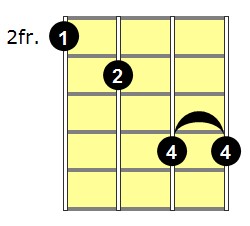
I grabbed this image from riffspot.com. This is my preferred Dm in first position.
D, A, and Am are all easily accessible with a little bit of tweaking. Also it's closed, do it has utility up the neck.

Wow that’s a tough one Patrick. Yes, it’s awesome because it’s moveable, but I am nowhere near using my pinky like that. I need to work that out
It's not too hard. From what you've posted elsewhere, I think once you get your Eastman, you'll find some of these fingerings easier. This site is a little weird, but useful; here he shows the 2-finger Dm:
 right on!
3 finger AFD like TSSN is showing except I don't fret the high A at all because that's too much work and a little too melodic most of the time IMO
Edited by - mandosoft on 04/14/2021 06:24:46
For what it's worth, Roland White's workbook has a lot of interesting and useful 2- and 3-finger chord groupings that work quite well together.
The OP seemed to have typed minor instead of major.
quote:
Originally posted by mmuussiiccaallThe OP seemed to have typed minor instead of major.
Quite right! I should have read more carefully.
"...fingers 1 on the G string and finger 2 on the E string..." is my approach to an open D major.
quote:
Originally posted by joemedWow that’s a tough one Patrick. Yes, it’s awesome because it’s moveable, but I am nowhere near using my pinky like that. I need to work that out
Take a hammer and break the pinky so it cannot bend...much easier that way. Actually I know exactly what you mean.
Depends on the situation / progression but there are a good number of minor chord options.
For D Minor specifically, I usually go with:
GDAE
235x
x355
735x
2335 (Dm7 though there's no root note in this - but it doubles as an F major chord too)
On Monday 6/27 I'll be posting a lesson that covers a variety of Minor Chord shapes with easy graphics that show the notes and the note functions (i.e. root, b3rd, etc). You'll be able to see that here once it's posted mattcbruno.com/chord-shapes/ on Monday at 8am PST
Bar string 1 and 2 at 5th fret, play the third string at third with the index finger at fret 3 and DON'T PLAY THE 4 th string. That would give you A D F an acceptable D min. This is a moveable chord. Move this shape 2 frets down the neck and you have an E minor chord. This is a shortcut and simple way to easily play all the chords.
I like Matt's first choice: 235X, also don't discount the "open chord" 2001. Here's my video on dealing with minor chords and the various possibilities: youtu.be/YvXROBtKJNs
I had to update my site - so the chord shapes moved :(
Here's the updated link: mattcbruno.com/mandolin-chord-shapes/
As well as the link to the Minor Shapes page: mattcbruno.com/2022/06/mandoli...r-shapes/
quote:
Originally posted by JosephpetrieHi,
Please forgive the ignorance of a noob. I have noticed that when playing a basic D minor chord...(A/D/A/F#) - i.e. second fret on the G and E strings, D and A strings open... I'm happy to put fingers 1 on the G string and finger 2 on the E string OR do it the opposite way round. Both seem fine to me.
Is there a right/wrong way ?
Joe
You say "minor," but it looks like you mean major, right?
Regardless, it's a good question. The right way to play anything is what's comfortable and sounds good for what you're doing at the moment.
Edited by - Charlie Bernstein on 04/03/2025 04:29:44
Terms of Use | Privacy Policy | Privacy Consent (EU/GDPR Only)
Copyright 2026 Mando Hangout. All Rights Reserved.